RHTP Year 2: What Changed?
No state moved more than 4%, but the basis for the money changed
CMS released the second year of Rural Health Transformation Program awards on November 9, 2026, and at first glance nothing happened. All 50 states got paid again. The total is still $10 billion. No state's award moved more than 4% from last year.
The dollar table is the least interesting part of the announcement. What changed is how CMS decides. Year 1 awards were a grade on a plan. Year 2 awards are, in part, a grade on execution, and CMS has now built the reporting machinery to make that grade matter more each year. With $30 billion still to be awarded across 3 more rounds, states that read this as a status quo renewal are misreading it.
What CMS changed
The statutory structure is the same. Half of each year's $10 billion is split evenly, $100 million per state. The other half, which CMS calls workload funding, is allocated on rural population and facility characteristics, the initiatives in each state's plan, state policy actions and other data-driven factors from the original funding notice.
The difference is what feeds that second half. In December 2025, CMS scored applications. This year, every state filed an annual report on its first-year progress, and CMS reviewed those reports in setting each award. The Year 2 fact sheet describes a checkpoint model for initiative-based funding: governance in place, project plans approved, initiatives launched, milestones hit, outcome measurement set up, sustainability planned.
Policy commitments are being checked too. The press release names 2 examples: the Presidential Fitness Test and nutrition continuing education for physicians. States earned points last year for promising these. This year CMS looked at whether they delivered.
Reporting gets heavier from here. More detailed quarterly reports begin this month, and CMS says it will use both quarterly and annual reports to inform future awards. That turns an annual review into something closer to continuous scoring.
CMS also published state obligation data through July 31, 2026, with a caveat that the figures alone neither measure progress nor set the Year 2 award. The caveat is fair. Publishing the table still tells every state that its pace of spending is now public and comparable.
One more change is in tone. The fact sheet goes out of its way to say an award can rise, fall or stay flat, and that a down year does not set a state's trajectory. Agencies write that sentence when they expect larger swings later.
Where the money moved
Because the workload pool is fixed at $5 billion, the round is zero-sum. Exactly 25 states gained and 25 lost. The biggest swing in either direction was about $7.4 million on awards that average $200 million.
| State | FY26 award | FY27 award | Change |
|---|---|---|---|
| North Dakota | $198.9M | $206.4M | +$7.4M |
| Iowa | $209.0M | $216.0M | +$7.0M |
| Montana | $233.5M | $239.7M | +$6.2M |
| Virginia | $189.5M | $195.7M | +$6.2M |
| Kansas | $221.9M | $225.9M | +$4.0M |
| Washington | $181.3M | $177.1M | -$4.2M |
| New York | $212.1M | $207.8M | -$4.3M |
| New Jersey | $147.3M | $142.3M | -$4.9M |
| Vermont | $195.1M | $190.0M | -$5.1M |
| Florida | $209.9M | $203.8M | -$6.1M |
Source: CMS award tables for FY26 and FY27; changes calculated from those tables.
The pattern leans one way. The largest gains went to plains and mountain states with deep rural footprints. The largest losses landed on big or northeastern states. The spread widened slightly: the floor fell from $147.3 million to $142.3 million (New Jersey) while Texas held the top spot at about $282 million.
CMS does not publish factor weights, so nobody outside the agency can say how much of any state's change came from progress reporting versus updated rural data. That opacity is itself a planning problem for states.
Louisiana came out ahead
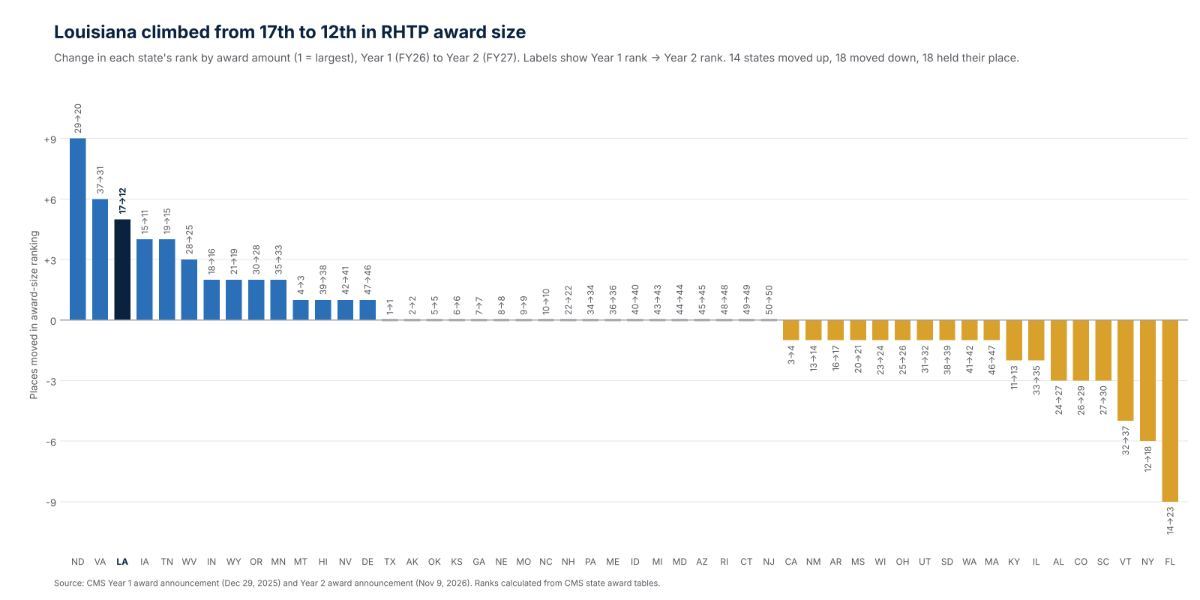
Louisiana's award rose from $208,374,448 to $211,858,378, a gain of about $3.5 million. That is 1.7% on the total and 3.2% on the workload half, the only half that can move. It was the 8th largest gain in the country and lifts Louisiana from the 17th largest award to the 12th.
The neighbors did not match it. Mississippi lost about $1.2 million, Arkansas lost about $1.0 million and Texas was nearly flat at +$0.7 million. Louisiana's result sits closest to Tennessee, Oklahoma and North Carolina, all up between $3.5 million and $3.8 million.
A gain in a zero-sum round, in the first year CMS weighed implementation, is a reasonable signal that the state's annual report and policy follow-through read well. It is a signal and not proof, for the reason above: the weights are not public.
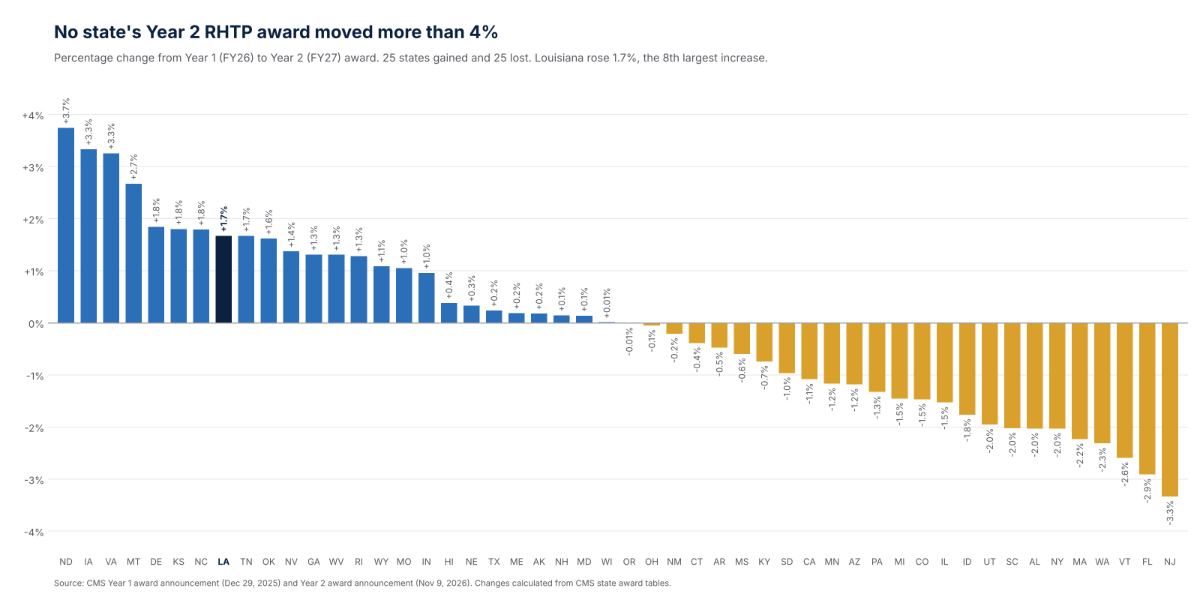
By percentage, Louisiana’s Year 2 award rose 1.7%, the 8th largest increase of any state. That’s the same position it holds by dollar change. Looking at percentages instead of dollars mainly reshuffles states with small awards. Delaware moves up to 5th at +1.8%, because a smaller base turns a modest dollar increase into a bigger percentage. New Jersey falls to last at -3.3%, behind Florida at -2.9%, even though Florida lost more money. Ranking states by award size shows more movement still. Most awards fall between $190 million and $220 million, so even a small change can move a state several places. Louisiana went from 17th to 12th, a climb only North Dakota and Virginia beat. Florida dropped from 14th to 23rd and New York from 12th to 18th. At the top and bottom, Texas and Alaska kept the largest awards and Connecticut and New Jersey the smallest. This ranking measures award size, not performance. The real story of Year 2 is how little the funding changed, which leaves execution as the main difference between states.
What to watch before Year 3
- Budget revisions are due to CMS by November 30. CMS missed its own October 31 notification deadline and announced 9 days later, which leaves states about 3 weeks to rework budgets around new numbers.
- Payment speed is the exposed flank. Becker's reported in late October that rural hospital leaders in several states were still waiting on payment for state-approved Year 1 projects. Obligating money and getting it to a provider are different things, and quarterly reporting will make the gap visible.
- Redistribution is now spelled out. Unexpended funds can be redistributed to other states under the statute, in a cycle separate from the annual award. Everything must be spent by September 30, 2032, or it returns to the Treasury.
- Swings will likely grow. A 4% ceiling in the first scored year looks like CMS easing states in. With quarterly data and checkpoints feeding the formula, FY28 has more to work with.
The practical read for state program offices: the application phase is over, and the plan no longer earns the money. Contracts executed, dollars in providers' hands, milestones documented and policy commitments completed are what CMS will be reading every quarter from now on.
Sources
RHTP: Who Got More and Why
Related Award Data analysis: CMS has now awarded $20 billion of the $50 billion Rural Health Transformation Program, $10 billion in each of 2 rounds. Every state…
RHTP Year 1: Full Timeline
In 14 months CMS took RHTP from a 124-page funding notice to awards scored partly on execution. States met every deadline but object…
Two Views of the Rural Health Fund
Related Award Data analysis: CMS has now awarded $20 billion of the $50 billion Rural Health Transformation Program. Round 1 went out in December 2025, round 2 o…